by Erik Wheeler
April 8, 2026
Divorce Mediation vs. Hiring a Divorce Attorney in Vermont: Which Is Right for You?
If you're facing a divorce in Vermont, one of the first questions you're probably asking yourself is: Do I need a lawyer? It's a fair question — and the answer might surprise you.
Most people assume that divorce automatically means attorneys, courtrooms, and a process that's both painful and expensive. But there's another path that the majority of divorcing couples in Vermont can take: mediation. And for almost all couples it works extremely well — even when things between you and your spouse aren't exactly friendly right now.
The Cost of Hiring Divorce Attorneys in Vermont
Let's talk numbers, because this is often where the conversation starts.
A contested divorce handled by attorneys in Vermont can easily cost $15,000 to $30,000 per person — sometimes more. That's not a typo. Each spouse typically retains their own attorney, and those attorneys bill in 6-minute increments for every phone call, email, document review, negotiation, and court appearance. Hourly rates for family law attorneys in Vermont generally run $250 to $400 per hour, and a contested case can consume dozens — or hundreds — of hours.
Even a relatively simple divorce handled through attorneys can run $5,000 to $10,000 per side before it's over.
Mediation, by contrast, typically costs $3,000 to $6,000 total — shared between both spouses. That's not per person. That's the whole thing. When you factor in that most couples I work with are able to file for an uncontested divorce at the end of the process, the savings compared to litigation are dramatic.
How the Two Processes Compare
| Divorce Mediation | Hiring Attorneys | |
|---|---|---|
| Cost | $3,000–$5,000 total (shared) | $15,000–$50,000+ (per side) |
| Timeline | 2–4 months, typically | 1–3 years for contested cases |
| Control | You and your spouse make decisions | Decisions made by a judge |
| Privacy | Private sessions | Court hearings are public |
| Tone | Collaborative, solution-focused | Adversarial by design |
| Outcome | Uncontested divorce filing | Contested or settled divorce |
| Attorney Involvement | Optional (you can consult one) | Required on each side |
| Flexibility | Agreements tailored to your family | Bound by what a court will order |
What Mediation Actually Is (And Isn't)
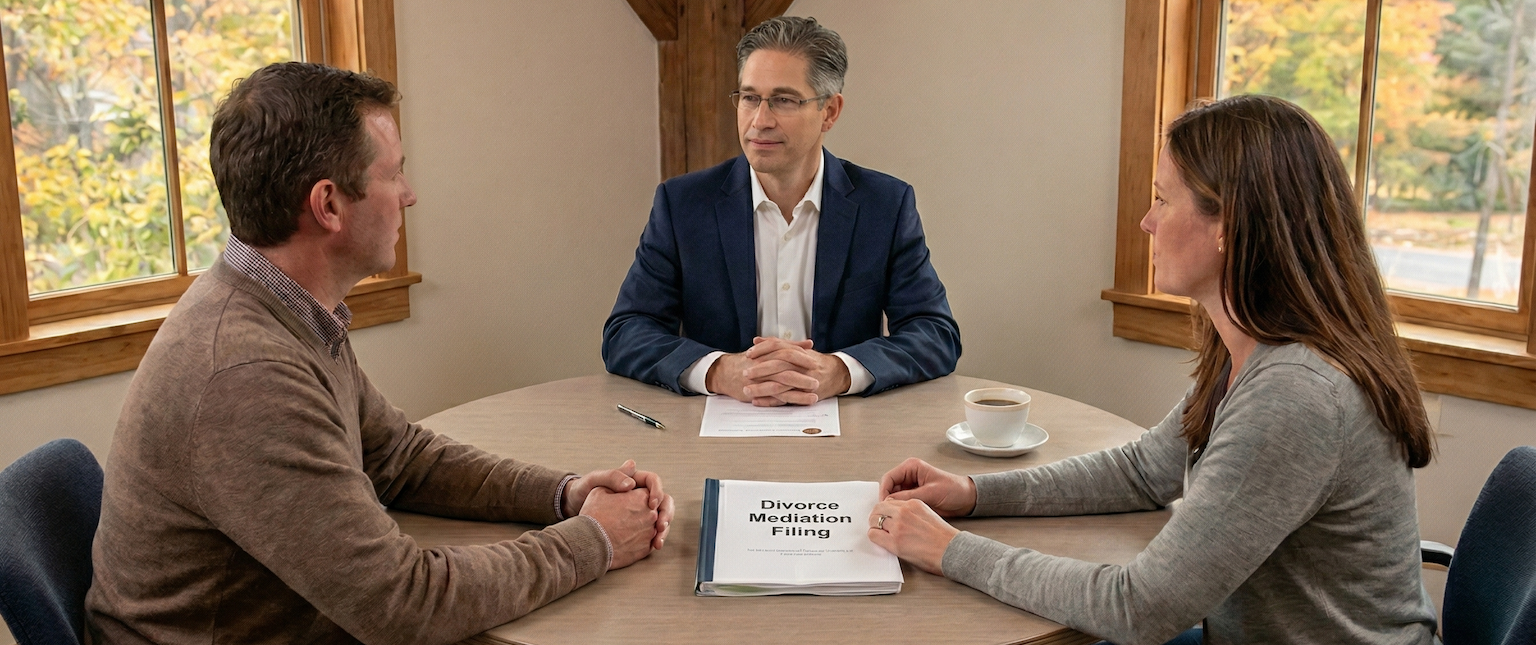
Mediation is a structured process where a neutral third party — the mediator — helps you and your spouse work through the issues you need to resolve: property division, debt, spousal support, and if you have children, parenting schedules and decision-making.
I'm not an attorney, and I don't represent either party. What I do is explain how Vermont divorce law works — what courts typically look at, what the legal framework is for things like property division or parental rights — so that both of you can make informed decisions. I can also draw on what I've seen work well for other families when it comes to parenting plans or dividing assets, and offer that as a starting point if it's helpful.
The decisions are yours. Mediation just gives you a process and a guide to get there.
"But We're Not Getting Along — Can We Still Use Mediation?"
This is the biggest misconception I encounter, and I want to address it directly: you do not need to be on good terms to use mediation.
Conflict is normal in divorce. Hurt feelings, disagreements about money, tension over the kids — none of that disqualifies you from mediating. In fact, mediation is specifically designed to help couples navigate exactly these kinds of disagreements in a structured, productive way.
You don't even need to be in the same room. Sessions can be held with spouses in separate spaces, and I can work between them. What matters isn't whether you're getting along perfectly — it's whether both of you are willing to work toward resolution.
The overwhelming majority of couples I work with — even those who come in with significant conflict — ultimately reach a full agreement. That agreement becomes the basis for an uncontested divorce filing in Vermont, which is faster, cheaper, and far less stressful than going to court.
When Does Mediation Work Best?
Mediation is a good fit for most Vermont divorcing couples, including those who:
- Have children and need to create a workable parenting plan
- Own a home, retirement accounts, or other shared assets to divide
- Have disagreements about finances, property, or custody
- Want to keep costs manageable
- Want to maintain control over the outcome rather than leaving it to a judge
- Are concerned about privacy
When Might You Need an Attorney Instead?
Mediation isn't the right fit for every situation. You may need to work with an attorney if:
- There is a history of domestic violence or abuse that makes it unsafe to negotiate with your spouse, even with a mediator present
- You have an extremely complex financial situation that requires legal representation (though consulting an attorney alongside mediation is also an option)
- A court order is needed urgently — for example, for immediate protection or emergency custody
It's also worth knowing that even if you choose mediation, either or both of you can consult with an attorney at any point to review what's being discussed or to get independent legal input. Many people do this, and it's entirely compatible with the mediation process.
What Happens After Mediation?
When you reach an agreement, I create all the court documents for you to file for an uncontested divorce.
Because the divorce is uncontested — both of you have already agreed on everything — the court process is straightforward and relatively quick. There's no messy court battle, no uncertainty about what a judge will decide, and no surprise legal bills.
The Bottom Line
Divorce is hard. The process doesn't have to be.
If you're wondering whether mediation might work for your situation — even if things are tense right now, even if you disagree on a lot — the honest answer is: it probably can. I'd encourage you to reach out for a free consultation so we can talk through the specifics of your situation and whether divorce mediation makes sense for you.
You deserve a process that's humane, affordable, and puts you in the driver’s seat. That's what mediation is designed to do.
Accord Mediation serves clients throughout Vermont. Contact us to schedule a free consultation.
Ready to Get Started?
To schedule your first session, email me at erik@accordmediationvt.com and include:
- Each spouse's name, phone number, and email
- Days/times that work for a 2-hour Zoom session
Free 20-minute phone consultation available
Call or text 802-391-4121.